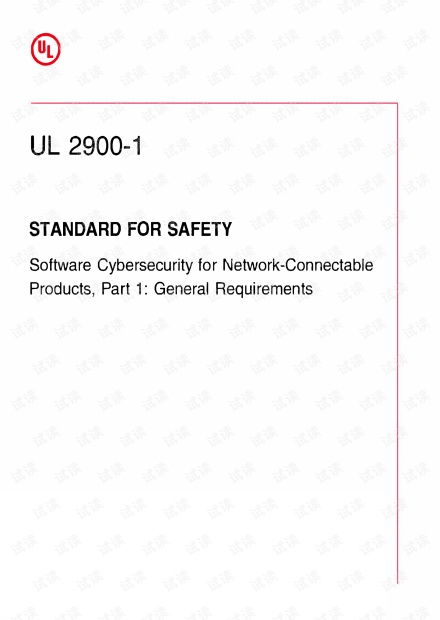
The proliferation of Internet of Things (IoT) and other network-connected devices has brought immense convenience and innovation, but it has also introduced significant cybersecurity vulnerabilities. In response to this growing threat landscape, standards such as UL 2900-1 2017 have been developed to provide a foundational framework for building security into connected products from the ground up. This document, titled "Standard for Software Cybersecurity for Network-Connectable Products, Part 1: General Requirements," serves as a critical guide for manufacturers, developers, and security professionals.
Core Purpose and Scope of UL 2900-1
UL 2900-1 establishes a set of testable security requirements for the software embedded within network-connectable products. Its primary goal is to assess the presence and effectiveness of security features designed to mitigate vulnerabilities, weaknesses, and malware. The standard is intentionally broad, applying to a wide range of products including but not limited to:
- Medical devices
- Industrial control systems
- Smart home appliances
- HVAC systems
- Security and alarm systems
- Any product with software that connects to a network
It focuses on the product's software, including operating systems, applications, and firmware, and its interaction with networked services.
Key Requirements and Framework
The 36-page document outlines a comprehensive, risk-based approach to cybersecurity. Its requirements are structured around several core principles:
- Risk Management Process: Manufacturers must establish and follow a formal risk management process. This involves identifying assets, assessing threats and vulnerabilities, evaluating potential impacts, and implementing appropriate risk mitigation controls.
- Security Architecture & Design: Security must be an integral part of the product's design phase. This includes principles like secure development lifecycle (SDL), defense-in-depth, and the principle of least privilege.
- Software Security Requirements: The standard enumerates specific technical requirements across multiple domains:
- Authentication and Authorization: Ensuring only authorized users and processes can access functions and data.
- Cryptography: Mandating the use of strong, up-to-date cryptographic methods for protecting data at rest and in transit.
- Software Integrity: Implementing measures like secure boot and code signing to prevent unauthorized modification of software.
- Data Confidentiality and Integrity: Protecting sensitive information from disclosure or tampering.
- Event Logging: Maintaining secure audit logs of security-relevant events for monitoring and forensic analysis.
- Software Updates: Providing a secure and reliable mechanism for distributing and installing security patches and updates.
- Malware and Vulnerability Mitigation: Incorporating features to resist common attacks and contain the impact of potential breaches.
- Testing and Evaluation: Products must undergo rigorous security testing, including static and dynamic analysis, penetration testing, and vulnerability scanning, to verify compliance with the stated requirements.
Importance for Network and Information Security Software Development
For professionals involved in network and information security software development, UL 2900-1 is more than a compliance checklist; it is a blueprint for building resilient products.
- Shifts Security Left: It institutionalizes the practice of integrating security early in the Software Development Life Cycle (SDLC), reducing costly post-production fixes.
- Provides a Common Language: The standard offers a standardized set of requirements that developers, product managers, and security auditors can use to align their efforts.
- Builds Trust and Compliance: Certification against UL 2900-1 demonstrates a manufacturer's commitment to security, helping to meet regulatory expectations (like those from the FDA for medical devices) and build consumer trust.
- Mitigates Supply Chain Risk: By requiring a security evaluation of third-party software components, it helps manage risks introduced by open-source libraries and commercial software development kits (SDKs).
Accessibility and the Role of Technical Resource Platforms
The full 36-page English version of this standard is a specialized document often accessed through standards bodies like UL Solutions. However, technical resource and community platforms like CSDN Download play a vital role in the cybersecurity ecosystem. They can serve as hubs for professionals to share knowledge, discuss implementation challenges, and access auxiliary resources related to standards such as UL 2900-1. It is crucial for developers to obtain the official standard from authorized sources for compliance purposes, while using community platforms for supplementary guidance and peer support.
Conclusion
UL 2900-1 2017 Part 1 represents a pivotal step towards standardizing cybersecurity in an interconnected world. By outlining general requirements for software security in network-connected products, it provides a essential foundation for developers to create safer, more trustworthy devices. As cyber threats continue to evolve, adherence to such frameworks will be paramount for any organization involved in developing the connected products of tomorrow.